

Choosing the right industrial door is a critical decision for logistics centers, warehouses,
distribution hubs, factories, production lines, cold storage facilities, and manufacturing plants. The right
door system improves workflow, supports safety, reduces energy loss, controls access, and helps maintain
temperature, hygiene, and security requirements. The wrong door can lead to downtime, higher maintenance costs,
poor insulation, traffic congestion, and unnecessary operational risks.
This industrial door selection guide for logistics and manufacturing provides practical,
SEO-friendly information for project planning, facility upgrades, and site specification. It covers door types,
core functions, selection criteria, common materials, performance ratings, dimensions, applications, and key
buying considerations. It is designed to help facility managers, project planners, engineers, architects, and
operations teams compare options and identify the best industrial door solutions for different
working environments.
An industrial door is a heavy-duty door system designed for commercial and industrial
environments where durability, frequent operation, security, safety, insulation, and size flexibility are
required. Unlike standard residential or light commercial doors, industrial doors are built to handle high-cycle
use, larger openings, mechanical stress, and demanding environmental conditions.
Industrial doors are widely used in logistics warehouses, manufacturing plants, loading bays,
cold rooms, clean areas, production facilities, garages, fire zones, and external building entrances. They may
operate manually or automatically, and they can be designed for fast opening, thermal control, impact resistance,
sound reduction, or access control.
A well-chosen door contributes directly to operational efficiency and facility performance. In logistics and
manufacturing, doors influence vehicle movement, material handling, internal climate stability, energy usage, and
workplace safety. Door selection should not be based on price alone. Instead, it should be matched to traffic
frequency, opening size, environmental conditions, security needs, insulation requirements, and maintenance
expectations.
Common reasons to invest time in proper industrial door selection include:
Industrial doors come in many configurations, each suited to specific use cases. Selecting the correct type is
essential for long-term performance. Below is a practical overview of the most common industrial door
types used in logistics and manufacturing.
| Industrial Door Type | Main Function | Typical Application | Key Benefit |
|---|---|---|---|
| Sectional Overhead Door | Vertical opening with insulated panels | Warehouses, loading bays, factories | Space-saving and well insulated |
| Roller Shutter Door | Rolls into a compact coil above the opening | Storage areas, external entrances, security zones | Strong security and compact design |
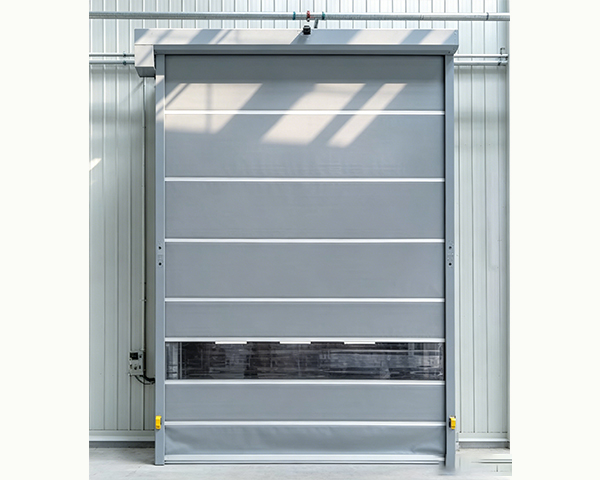
| High-Speed Door | Opens and closes rapidly to control traffic and air exchange | Production lines, clean rooms, logistics corridors | Fast cycle times and improved efficiency |
| Sliding Industrial Door | Moves horizontally along a track | Large openings, wide access points, hangar-style spaces | Suitable for very large door openings |
| Fire-Rated Industrial Door | Designed to slow fire spread and protect compartments | Fire zones, evacuation routes, compliance applications | Supports safety and regulatory requirements |
| Cold Storage Door | Minimizes thermal leakage in low-temperature environments | Refrigerated warehouses, freezer rooms, food logistics | Helps maintain internal temperature |
| Traffic Impact Door | Flexible door for frequent contact and movement | Internal logistics routes, kitchens, processing areas | Withstands repeated impact and frequent use |
| Pedestrian Industrial Door | Access for staff and controlled entry points | Factories, staff areas, secure rooms | Improves access control and convenience |
In logistics and manufacturing, industrial doors are used in a wide range of operational zones. Each area has
different requirements for speed, insulation, security, and durability. Matching the right door to the right
location helps improve process flow and reduce operational friction.
The best industrial door selection guide always starts with the application. Different facilities
have different priorities, and the ideal door must balance performance, durability, safety, and cost. The
following factors should be reviewed before specifying any door system.
High-traffic environments such as logistics hubs and busy factories need doors with strong cycle ratings and fast
operation. If a door opens hundreds of times per day, durability and cycle life become more important than initial
purchase price. High-speed doors and robust sectional doors are often preferred in these settings.
The width and height of the doorway determine the door type that can be used. Large vehicle access points may
require sectional doors, roller shutters, or sliding industrial doors. Smaller personnel access points can often
use pedestrian industrial doors or rapid access doors.
In climate-controlled environments, door insulation affects energy consumption and product quality. Thermal
efficiency is especially important for cold storage, food logistics, pharmaceutical handling, and heated
production areas. Insulated panels, tight seals, and low air leakage help maintain stable internal conditions.
Some facilities require strong resistance to forced entry, unauthorized access, or vandalism. Roller shutter
doors and reinforced sectional doors are commonly used where security is a top priority. The level of security
should be matched to the value of the stored goods and the risk level of the site.
Industrial doors may be exposed to wind, dust, moisture, temperature variation, chemicals, or corrosive
atmospheres. Door material and hardware selection should account for the environment. For example, stainless
steel, coated steel, or corrosion-resistant components may be needed in harsh settings.
In food processing, clean manufacturing, or pharmaceutical environments, door selection must support hygiene and
contamination control. Smooth surfaces, easy-clean materials, and rapid closure can reduce dust transfer and
airborne contamination.
Safety is a major factor in industrial door selection. The door should support safe opening and closing, obstacle
detection, emergency release, and code compliance. Fire-rated systems, pedestrian safety features, and access
control options may be necessary depending on the site.
A door with a low initial cost may still be expensive over time if it requires frequent repair or replacement.
Businesses should consider total cost of ownership, including installation, spare parts, service access, and
downtime risk.
Material selection affects strength, insulation, weight, corrosion resistance, appearance, and long-term
durability. The most common materials used in industrial door systems are summarized below.
| Material | Advantages | Common Use | Limitations |
|---|---|---|---|
| Steel | Strong, durable, secure | Roller shutters, sectional doors, security doors | May require corrosion protection |
| Aluminum | Lightweight, corrosion-resistant, clean appearance | High-speed doors, modern industrial entrances | Less impact-resistant than heavy steel in some cases |
| Stainless Steel | Excellent corrosion resistance, hygienic surface | Food processing, clean areas, wet environments | Higher material cost |
| Insulated Sandwich Panels | Good thermal performance, energy efficient | Sectional doors, cold room doors | Performance depends on panel thickness and sealing |
| PVC / Flexible Fabric | Fast operation, flexible, lightweight | High-speed doors, internal separation doors | Lower rigidity than metal doors |
| Reinforced Composite | Balanced strength and weight | Specialized industrial applications | Specification varies widely by manufacturer |
When comparing industrial doors, it is important to review technical specifications rather than relying only on
appearance or basic descriptions. Key specifications affect suitability for logistics and manufacturing
environments.
| Specification | What It Means | Why It Matters |
|---|---|---|
| Cycle Life | Expected number of open-close operations | Important for high-traffic industrial facilities |
| Opening Speed | How quickly the door opens and closes | Affects productivity, air exchange, and traffic flow |
| U-Value / Thermal Transmittance | Measures heat transfer through the door | Lower values usually mean better insulation |
| Air Leakage | Amount of air passing through seals and gaps | Important for energy efficiency and climate control |
| Wind Load Resistance | Ability to withstand external wind pressure | Critical for large external openings |
| Sound Reduction | Ability to reduce noise transfer | Useful in manufacturing and busy logistics zones |
| Impact Resistance | Ability to handle collisions or knocks | Important in forklift areas and busy traffic routes |
| Fire Rating | Resistance time under fire exposure | Required for fire separation and compliance |
| Ingress Protection | Resistance to dust and moisture entry | Useful in harsh or sanitary environments |
Different logistics and manufacturing facilities have different operational patterns. The table below provides a
general guide for matching door types to common industrial environments.
| Facility Type | Recommended Door Characteristics | Primary Reason |
|---|---|---|
| Warehouse | Durable, secure, insulated, moderate-to-high cycle | Balanced performance for access and energy control |
| Distribution Center | Fast operation, high-cycle durability, dock compatibility | Supports rapid vehicle and goods movement |
| Manufacturing Plant | Strong, safe, process-friendly, low maintenance | Works with internal production flow |
| Food Processing Area | Hygienic, easy-clean, insulated, contamination-resistant | Supports sanitary requirements |
| Cold Storage Facility | Excellent insulation, tight sealing, fast closure | Reduces temperature loss and condensation |
| Clean Room | Rapid movement, sealing, smooth surfaces, low contamination | Helps maintain controlled conditions |
| Automotive Plant | High-cycle, impact-resistant, large opening compatibility | Supports equipment and vehicle access |
| Metalworking Facility | Robust, secure, fire-aware, durable | Handles challenging industrial conditions |
The right door delivers measurable operational benefits. For logistics and manufacturing teams, these benefits can
support productivity, safety, and profitability over the long term.
Modern industrial doors may include a range of performance-enhancing features. Not every application needs every
feature, but many facilities benefit from selecting doors with the right combination of functions.
| Feature | Description | Typical Benefit |
|---|---|---|
| Automatic Operation | Motorized opening and closing | Improves speed and reduces manual effort |
| Safety Sensors | Detect obstacles or movement in the path of the door | Reduces the risk of injury or damage |
| Insulated Panels | Thermal core construction | Improves energy efficiency |
| Vision Panels | Transparent sections for visibility | Improves awareness and traffic safety |
| Manual Release | Allows operation during power failure | Supports emergency access and continuity |
| Brush Seals / Rubber Seals | Sealing components around the door edge | Reduces air leakage, dust, and noise |
| Crash-Friendly Design | Door can absorb impact or reset after contact | Useful in forklift and pallet traffic areas |
| Access Control Integration | Connects with card readers, keypad, or automation systems | Improves security and process management |
When evaluating different industrial doors, it helps to use a structured comparison method. The following checklist
can simplify the decision-making process and improve specification accuracy.
Industrial doors are often customized to fit the structure and operation of the building. Standard sizing can vary
by region, but most industrial sites require tailored measurements based on equipment, vehicle dimensions, and
architectural constraints. Door size affects performance, installation complexity, and operating efficiency.
| Sizing Factor | What to Measure | Why It Matters |
|---|---|---|
| Clear Width | Horizontal opening available for traffic | Must fit vehicles, pallets, and equipment |
| Clear Height | Vertical opening available | Important for trucks, forklifts, and tall loads |
| Side Space | Space beside the opening | Affects track, frame, and mounting options |
| Headroom | Space above the opening | Critical for overhead or rolling door systems |
| Rear Clearance | Space inside the building behind the opening | Needed for movement, stacking, or track positioning |
Proper installation is essential for safety, performance, and durability. Even a high-quality industrial door can
underperform if installed incorrectly. Site preparation, frame alignment, power supply, control integration, and
final testing all matter.
Regular maintenance helps extend service life and reduce unplanned downtime. Maintenance schedules should reflect
usage intensity and environmental conditions. High-cycle doors typically require more frequent inspection than
low-use access doors.
| Maintenance Task | Recommended Purpose | Typical Frequency |
|---|---|---|
| Visual inspection | Detect damage, wear, or misalignment | Weekly or monthly |
| Seal inspection | Check air leakage and weather resistance | Monthly |
| Hardware lubrication | Reduce friction and wear | As required by usage |
| Safety system testing | Confirm sensors and emergency features work correctly | Regular scheduled testing |
| Motor and control review | Maintain automatic operation reliability | Periodic service inspection |
| Balance and alignment check | Prevent strain on door components | Routine preventive maintenance |
Many door problems can be avoided by planning carefully at the specification stage. The most common mistakes
include choosing a door only by price, ignoring cycle frequency, underestimating insulation requirements, and
failing to account for traffic type or environmental exposure.
Use the checklist below as a practical reference when comparing industrial doors for logistics and
manufacturing.
| Checklist Item | Yes / No | Notes |
|---|---|---|
| Door type matches application | Sectional, roller shutter, high-speed, sliding, etc. | |
| Opening size is confirmed | Clear width, height, and available space verified | |
| Traffic frequency is defined | Daily cycle count estimated | |
| Insulation needs are identified | Thermal control or energy savings required | |
| Security level is established | Access control or intrusion resistance needed | |
| Environmental exposure is reviewed | Wind, moisture, dust, or chemicals considered | |
| Safety features are included | Sensors, emergency release, and compliance | |
| Maintenance plan is available | Inspection and service schedule planned |
For SEO purposes, industrial door content often performs well when it includes clear keyword phrases related to
the main use case and product category. Common search terms include:
Selecting the right industrial door for logistics and manufacturing is a strategic decision that
affects efficiency, safety, security, and long-term operating cost. By evaluating door type, cycle frequency,
opening size, thermal performance, environmental exposure, and maintenance needs, businesses can choose a door
system that supports both current operations and future growth.
Whether the goal is faster material flow, improved insulation, better access control, or stronger workplace
safety, the right industrial door plays an essential role in facility performance. Use this guide as a practical
reference when creating blog content, category pages, industry pages, specification sections, or procurement
resources focused on industrial door solutions.
```
Thẩm Dương Manlong Metal Products Co., Ltd.


Bản quyền © 2026 Thẩm Dương Manlong Metal Products Co., Ltd. Bảo lưu mọi quyền Ứng dụng
Trang web này sử dụng cookie để đảm bảo bạn có được trải nghiệm tốt nhất trên trang web của chúng tôi.

 English
 Español
 Portugues
 Pусский
 Français
 Deutsch
 العربية
 ไทย
ไทย Türk dili



 Điện thoại
Bình luận
(0)